Friday, 5 May 2023

Ponniyin Selvan II: Thoroughly engrossing although not epic!


Who are kings, if not mere mortal men of flesh and blood, but those who aspire to be immortalized by their deeds. A story of kings can also be a story of men, which is what Mani Ratnam chooses to show in his two-part magnum opus. He humanizes the kings, putting emotion ahead of their ambition, and tries to create more poignant moments than epic ones on screen. He almost treats Ponniyin Selvan like a grandly orchestrated play where the actors and their lines are more important than any other aspect, be it the landscape, the fortresses, the weapons, or the wars. Maybe that’s not what we expected when we went in to see PS-I, which may have been cause for bit of heartache, but we knew the maker’s intentions quite well when we went in to watch PS-II.

For a movie set on a scale bigger than most Indian movies, PS-II narrates events occurring over a relatively short period of time. You could say that the entire movie is based around one grand conspiracy with little or no space for subplots in between. Mani Ratnam trusts the quality of the source material and the main thread of events to keep the viewer engaged through the entire duration. And, it is no small vindication of Kalki’s epic that even with bare-minimum detailing of the complex evolution of the story, the events keep you invested almost through the entire run time. Mani Ratnam chooses to plainly narrate many of the key details/events without going into how they might have occurred. For example, how Nandini maintains communication channels with the Pandya spies and how she manages to escape all the attention of palace guards to get to their hideout is anybody’s guess. This is amongst the most important events in the scheme of things, but is shown on screen like it is a casual evening saunter for Nandini. Again, what makes these scenes work is that Mani Ratnam manages to firmly establish very early in the movie (and through PS-I) the emotion that drives these characters. Therefore, even though we may find ourselves questioning the ‘how’ of certain things that happen on screen, we never question the ‘why’. The ‘why’ is very strong and very clear, which is what gives life to the movie.

PS-II is all about Nandini, Aditha Karikalan, Arunmozhi Varman, and Vandiyathevan, with Kundavai having a couple of key contributions. And with the approach that Mani Ratnam has chosen, the burden on the shoulders of the actors portraying these characters was immense. Especially, Nandini and Karikalan; it is the crescendo of the simmering tension of years between the two characters that is the high point and the driving force of the movie. It’s amazing to think that the two characters whose equation controls the whole movie come face-to-face just once and that too for a precious few minutes. But, that moment is seized so powerfully by the actors that you are not left with an iota of doubt about ‘why’ these characters are doing what they are doing. Here again, Mani Ratnam treats it almost like a stage play – minimalistic camera angles, minimal editing, just two actors who know the sheer weight of the moment and execute it to perfection. In fact it’s so perfectly done, it feels like the climax and everything after that seems like a footnote to the story of Nandini and Aditha Karikalan. That’s both a tribute and a smirk at how Mani Ratnam has made the Ponniyin Selvan saga – while he has managed to capture the emotional essence of the main characters, he has not added (perhaps intentionally) a kinetic energy to the narrative, which would have made the PS duology a masterpiece in its own right. One aspect that non-Tamil audiences may not quite connect with would be the fuss about the Chola empire. At no stage in the movie does the screenplay make an attempt to show what the Chola empire and its kings mean to its people, and why its survival is so important. Except for the personal connection with the characters, it’s unlikely that the audience feel any allegiance or goodwill toward the empire.

The frames are rich, the locations have been picked carefully, but yet, at no point during the two films did you feel that you are watching an epic. It’s difficult to put a finger on what would make a movie an epic; but whatever it is, went missing in PS. Maybe it is a combination of many factors, including the music, but it never really came together for PS, which also may be because the team never intended it to be that way. In fact, Mani Ratnam makes very economical use of Rahman’s music, choosing rather to hop directly to the next main event rather than linger in moments with music and songs. And, that decision has worked well for the movie with things always moving ahead at a rapid pace. The only moment when you actually want it to slow down and linger with the music is when Aga Naga plays in the background of the most Mani Ratnamesque scene in the entire movie, you just don’t want that scene to end. It says a lot about the sheer skill of Mani Ratnam in such situations when you realize that in a movie of nearly 3 hours with kings, queens, wars, conspiracies, mind games, politics, and treachery, the one scene you want to watch over and over again is where two lovers (well, not yet at that point perhaps) meet each other on a nondescript islet in the middle of a river. Mani Ratnam needs no context, no character building, and no set up (this is the first time the characters face each other in PS-II); he executes a mellifluous moment of beauty. In fact, this is the only time you see Mani Ratnam add his signature or flavor to Ponniyin Selvan. This is his home ground, and we hope he makes love stories with such beautiful moments rather than go after large epics, which may be his ambition, but are certainly not his strongest suit.

One grouse that many may have against PS-II is about how the wars and confrontations have been shot. It’s almost like Mani Ratnam treated them like functional bits in the narrative because they just had to be shown on screen. He just wanted to get them over with and has put very little imagination or resources into it. That shows on screen. Perhaps in the pre-Bahubali era of Indian cinema, this might have passed muster, like a Jodha Akbar did. But, the benchmark has now been set and Mani Ratnam should have been up for the challenge when executing an epic that deserved to be treated like one. This is not to say that all such scenes fall flat, the moment before the interval does pack a punch. However, this scene again shows how Mani Ratnam is more comfortable in the subtle rather than the over the top!

PS-II is beautifully and powerfully orchestrated at the emotional level, with the motives of the central characters being conveyed very effectively. Mani Ratnam shows that even comfort castings, like Prabhu as a military leader, can work if the emotional anchor of the movie is in the right place. The same Prabhu looked so out of place as a strong right-hand man in Marakkar, which tried to be epic without bothering in the least about the ‘why’ of any of the characters. However, directors of both these movies could have been more careful with the use and control over the extra actors.

Watching PS-II is like watching an engrossingly written play being performed by skilled actors. The scale and the backdrop don’t really matter because the movie lives and breathes through the emotions of its lead characters. The only thing you have to do as an audience is to not walk in with an epic in mind.

Saturday, 20 February 2021

Drishyam 2 - Has there ever been a better sequel?


Seven years back, in the final minute of a full-length feature film Jeethu Joseph delivered a knockout punch that can still be felt in some parts of the world as language after language seeks to remake this story. Such was the perfection of Drishyam that no one envisaged this story going forward. It was there, complete, perfect, the perfect cover up of an amateurish crime. Taking the story forward would be like attempting to build an annexe to the Taj Mahal, or adding a blush to the cheeks of Mona Lisa - both fraught with more risk than potential reward. While these might look like comparisons that are too lofty, the fact that a small unassuming movie (Mohanlal was the only big thing about Drishyam back then) from Kerala now has a remake in China and one in the pipeline in Hollywood - we are used to doing things the other way round - says enough about how much it means to Indian cinema.


We thought Drishyam was finished business, but Drishyam 2 is about Georgekutty and a few others who believe that there is business yet to be finished. Both the protector and the persecutor do not let their guard down and that’s how things come to a second precipice. As one of the character’s says, ‘This is a war, started by him (Georgekutty), and I like to win my wars’. Wars are not won easily. They are won by the ones willing to ‘dig deep’ trenches and hold fort, waiting for the right time to act. This story is also about two sides waiting patiently in their trenches looking for the slightest threat or opportunity. It is this excruciating battle of wits and patience that Jeethu Joseph has written with painstaking perfection, making Drishyam 2, in every way possible, a worthy sequel to the phenomenon that was Drishyam.


A dead body lying deep under the circle inspector’s seat at a local police station. A police investigation that was reprimanded by the court. The parents of the dead who had left India for good. And no witnesses! Only the infamous Sukumara Kurup could have thought of a more perfect crime. What more is there to be done? This makes us think of that famous line by Mammotty from ‘The Truth’ about how ‘truth’ finds a way to come out no matter how deep you may bury it. That’s where the movie begins, showing us a glimpse of how the truth may ultimately be revealed. But, Drishyam 2 is not just about that. It’s way more than a simple uncovering of the truth. Jeethu delves into the present day lives of Georgekutty and family, showing us the scars of a crime they had to commit and the trauma they endure to this day. That’s where Jeethu shows his class as a writer! He keeps the very tempting reveal in the background and takes us into the psyche of the family so well that for a brief while we forget that bigger trouble might be awaiting them later. Though it might not look obvious, every character in the family has been given an individual battle to fight. Be it Georgekutty, his wife or the daughters, everyone carries a weight in their minds and has to fight off demons in their own way. For a while, we even believe what Jeethu Joseph so tactfully said in his interviews - that this is a movie tracing the psychological journey of the family after the crime. Perhaps, that was his biggest masterstroke, because he jolts us out of the lull with a startling revelation that might have created reverberations in theaters as an ‘intermission block’.


Jeethu Joseph has strained every sinew of his imagination to come up with this ingenious plot. As we go deeper into the second half, and more and more layers are revealed to us, our eyes open wider. It’s one thing to write outlandish plots with fancy elements, but it’s a totally different game to weave an intricate plot about one man against an entire police force, and yet not once go into the realm of the impossible. Yes, the story does travel in a way that many of us may consider improbable, but not once can you call it ‘impossible’. That tremendous balancing act by Jeethu is what makes Drishyam 2 a truly mind blowing experience. There are many points in the movie where we begin to ask questions about how certain things might have happened. But, Jeethu covers all that with answers in one way or the other. And these answers don’t come on screen like an ‘explanation reel’, which is a technique used in many thrillers where the viewer is shown what exactly had happened. The answers are given to us by characters that are planted so seamlessly into the screenplay in the first half. Even the most movie-crazed minds might not be able to pick the purpose that some characters have in the screenplay until Jeethu chooses to reveal it himself. At this point, I’m willing to put this piece of writing alongside the likes of Agatha Christie for sheer brilliance. Saying anything more would be a spoiler.


Jeethu the writer was absolutely magnificent in Drishyam 2! Jeethu the director executed the script as required. It’s no secret that Jeethu banks on his actors to produce good performances rather than get it out of them. That difference is clearly visible. The scenes that have the experienced actors look like poetry motion and the ones with the extras look merely functional. We are nitpicking here for such a finely made movie, but one wishes that some of the ‘nattukar (the people of the town)’ were chosen better. Especially the three-four auto drivers who have conversations amongst themselves plainly look like they are saying rehearsed lines that they don’t really believe in. Covid compulsions might have forced those choices, and so we will let them pass, and in the end they look like minor glitches in an otherwise spellbinding product. The one thing you do notice about Jeethu as a director is that he trusts his audience to spot the key moments and remember them as the movie goes along. It’s common practice to let the camera linger a second longer than necessary, or to add an additional sinister angle with an equally sinister BGM to register important moments strongly in audience memory. Jeethu does not do that, instead puts faith in the audiences’ intelligence, which is also one of the reasons that each major twist surprises us that much more. It may be an overstatement, but the screenplay is so good that it makes much of the technical departments merely functional instruments to narrate the story. But, at places the editing stands out with its crispness, especially in the big reveal moments with each character’s awestruck reaction being shown effectively without wasting much time.


The genius of Mohanlal is often said to be his effortless acting. But, Drishyam 2 is proof that there is a very strong method to this effortlessness. You can’t be the same Georgekutty twice seven years apart without having a deep understanding of the character and it’s evolution. Unlike Drishyam, the sequel places more onus on Georgekutty and lesser space for his family into the second half. A man carrying a secret close to his heart and living every minute with a conscious effort of not saying a word that may spill the truth - that is not an easy thing to depict on screen. Knowing the screenplay inside out is the only way Mohanlal could have so perfectly known exactly how much to ‘give’ in each scene! Drishyam 2 shows us that Mohanlal is spontaneous with a method! The synergy between the lead pair is such a pleasure to watch on screen. It’s almost as if the family lived those 6 years carrying that trauma in their hearts and minds. Meena is subtly effective while Ansiba is challenged with some tough moments that she aces. Esther also shows her teen transformation with ease. But, the man who comes a very close second to Mohanlal is Siddique as Prabhakar. He might not play the most important character in the scheme of things, but everytime he is on screen he makes it count. The moral jeopardy of a man torn trying to find the middle ground between retribution, justice and forgiveness is beautifully expressed on his face. And as one of the characters wonders aloud in this movie, if all men were like Prabhakar, the world might be a much better place. Murali Gopi bites deep into the best character he has yet been offered by another writer. We only pray that he doesn’t get so busy as an actor that he can’t find time to write! Asha Sharath as Geetha Prabhakar unleashes herself in one interrogation scene that crackles with all the pent up anger and frustration.


All other things aside, Drishyam 2 is about the absolute commitment of the writer to come up with a screenplay that would not let down anyone who has seen Drishyam. One can only imagine the number of times he would have thought, written and re-written and reverse engineered this screenplay to make it as watertight as it is now! It would be too much to ask that every writer do this for every screenplay, but surely any writer attempting a sequel to a celebrated movie should treat Drishyam 2 as a benchmark. Drishyam 2 is about Jeethu Joseph not being tempted by the easy benefits of a sequel and not being overawed by the task at hand. As Georgekutty, he waited, bided his time, and when the opportunity came - he was ready!


Tuesday, 2 February 2021

Master Review: Lokesh is still a 'mass' apprentice!

There is a scene towards the end of Master where Vijay looks at the camera (not directly, at an angle) and no one else is on screen. He points out his hand and proclaims ‘there are crores out there who like me’! That is the point where it became painfully obvious that Lokesh Kanagaraj had completely sold out to the idea of a star-driven Tamil commercial movie. There were strong indications right from the beginning, but you were willing to give the benefit of the doubt to a young director making his first big movie with the weight of expectations from his previous success. But this moment, which pandered to nothing else but the stardom of the leading man, is not the product of a young naive filmmaker trying something new or different. This can be done only in complete anticipation of the claps and whistles that the fans might generously shower. Lokesh Kanagaraj sold out to ‘mass’! It’s not a crime, neither is it cinema of unacceptably low standards. But it definitely hurts to see a potential torchbearer of pure cinema turn into a candle-bearer to an actor’s stardom! 


That’s not to say all is lost for Lokesh Kanagaraj. The very beginning of the film shows that he has his fingers firmly on the pulse of the story as he introduces us to JD, the professor. The hero ‘intro’ is carefully set up, showing that the young director has evolved and learnt quickly the ropes of presenting a star on screen. But, the problem is that the screenplay does not know where to stop gaping at the star and get on with the business of telling the story. You get a stretched intro fight followed by an out of place intro jingle at the end of which the education minister (who has been made to wait until the hero arrives) gives a mini speech extolling the qualities that might have made this person (who he has not yet met) so popular with the students. When the screenplay does start motoring along the movie looks good. That exactly is the problem with Master! A fairly engaging plot punctuated with irritating speed breakers that serve no purpose, except stretch the movie to the three hour mark.


There are things in Master to be liked. The way Vijay’s character has been set up, giving him a vice (very rare in Tamil cinema, though not non-existent, Katthi for example) of his own to overcome, make him fallible, imperfect. These are welcome changes, but the filmmaker did not have the gumption to go the whole way with it. Even with those imperfections, he is a hero among the students, speaks strongly against the establishment and has all the qualities that make the quintessential Tamil hero. When the time comes for him to look himself in the mirror change for the better, he does so with the ease of flipping a switch. Years of alcoholism gone in a flash leaving behind no signs, no withdrawal symptoms. It’s not that it makes much of a difference because he was the hero even when he was an alcoholic, just that he switched off after 6 pm. Now, he is a hero round the clock. It’s this unwillingness to go the whole way with an idea that stops Master from being truly out of the ordinary. The hero has his demons, but manages to fight them off overnight - which makes the demons seem pretty weak!


But, Master is more the story of Bhavani than JD. Master is ambitious with it’s villain right from the beginning. There is an attempt to construct an almost mythical sort of villain figure, not much unlike Siddharth Abhimanyu of Thani Oruvan. But, while Siddharth banked more on sophistication in his crimes, Bhavani believes in savagery that none can match up to. There is a moment in the film when the hero wonders aloud about whether the villain’s genitals were not visible when he was given the name ‘Bhavani’. So much for class! And, we thought that’s as low as it can get when the villain proudly proclaims later that he was indeed in a position where his genitals were on display. You get an idea of the kind of villain Bhavani is. Ruthless, cold blooded and always willing to hit below the belt. The hold that Bhavani has over the juvenile correctional home, the workings of the nexus and the terror that Bhavani wields are well etched in the screenplay, which makes for a sumptuous set up for the hero-villain clash. But, the screenplay refuses to get to that point in any hurry. We meander through a meaningless montage of the bucket-wielding hero smashing people in the face, and sit through a Thuppakki-inspired sequence where the villain finishes off people in the hero’s friend list, a kabaddi match that seems to be there only to give us some ‘Ghilli’ nostalgia. We think that the director might have at this point run out of ideas to stretch the film further. But, he surprises us with a sequence where the hero manages to deliver a monologue that instantly reforms 3-4 convicts - we thought that thing had ended in the 2000s! Then he gives us a lorries vs arrows match which is not entirely bad because for a change it’s not the hero doing the shooting! Oh, we thought too fast. How can someone else steal the hero’s thunder for too long in a Tamil movie? Soon, we have the hero shooting arrows. The arrows which till that point were either breaking glass or puncturing tyres suddenly became potent missiles in the hands of the hero, sending lorries lunging over mounds of sand. By the time we hear the ‘kutti story’ beat come out of a container we have no patience left. But wait, the hero and villain have yet to come face to face (they do share a face to back sequence earlier).


Vijay Sethupathi does his thing like only he can. The Bhavani character though strongly written is not anything new to Tamil cinema. The ruthless villain who strikes fear even in the hearts of his co-criminals. The villain who plunges a knife into a chest in the middle of a jovial conversation. One can see shades of Joker here. But, it’s nothing new. It’s just the amazing spontaneity of the Makkal Selvan that keeps the character fresh in our minds. One is tempted to name him ‘Brick Knuckle Bhavani’ for the punches that he throws. But, even Brick Knuckle Bhavani goes into standby mode in the final fight as the hero delivers one last monologue to his students who wildly cheer him! There is one sequence in the fight that highlights the gulf between the two actors. Both are required to sing a song after knocking the opponent down. While VJS does his ‘Jaam Bazaar jakku’ routine with such ease, mixing arrogance, nonchalance and sarcasm, Vijay stages a ‘Vazhakka bajji’ antic which will be trolled in the years to come. 


Master has proved that Lokesh Kanagaraj is a fast learner. From shooting with a very limited cast to making a mob fight on a college campus, the director has graduated to the big league in terms of scale. He has also learnt the art of playing to the gallery with slow motions and pumping BGM supplied in ample measure by Anirudh. The director might learn the fine line of balancing these mass elements as he goes along, but he has definitely overdone it by a fair bit in Master. He has also written in a cute little trait into Master’s character where Vijay keeps coming up with inane back stories explaining why he became an alcoholic. He also gives the villain character a ‘2 minute’ punchline every time he’s getting ready for action. These touches work well and tell us that behind the taut screenplays that were written for Maanagaram and Kaithi, there is also a writer who enjoys the more softer genres of cinema. We only wish the writer was able to come up with a stronger reason to connect the first hour of the screenplay to the main act. Here, it dangles by a string that the editor might have been tempted to cut had it not demanded the unthinkable act of cutting out the star’s intro fight and song. What Lokesh Kanagaraj has done well though is push Vijay slightly out of his comfort zones in terms of performance. We do not know whether the quirk of constantly pulling up his pants was the director’s or the actor’s idea, but it does add credibility to the overall unkempt nature of the character in the first hour.


Master promised so much, mostly because of Kaithi. It’s difficult to say whether it’s unfair to judge a movie based on the director’s previous work. But, even viewing it without the weight of Kaithi is not a satisfying experience. Lokesh Kanagaraj is not caught in two minds as Pa Ranjith was when he got the chance to make movies with Rajnikanth. Lokesh decides to go full on ‘mass’ mode. But the problem is he does not have a screenplay that backs up his mass ambitions and ends up giving us a mish-mash of slow motion montages, songs and painfully obvious references to Vijay’s previous blockbusters (the TN assembly should soon pass a legislation banning the use of ‘I’m waiting’ references in interval blocks of Tamil movies) with the only relief being a delightfully spontaneous Vijay Sethupathi who adds his spice to the regular villain character. Master proves that when it comes to ‘mass’, Lokesh is still an apprentice!


Wednesday, 25 November 2020

SUPER DELUXE

 Super Deluxe! What's Super about this?

There’s what you do, and what you don’t – nothing’s right or wrong says Thyagarajan Kumararaja in his second movie. He treads the line between the real and the surreal in bringing together multiple strands of narratives into an ending, well multiple endings! The connections are quite tangential, like they were brought together so that it could be one feature film, not an anthology of short stories. The stories themselves look like they were written by different writers (as they are) with almost no idea of what the other writer was up to. In spite of that, one wonders how almost every writer (save the guy who wrote the character played by Mysskin) paints at least one guy in his story as a total dick. Really, men in this movie are portrayed as if they think only through their hard on, which they seem to have in their pants even when faced with the harshest of circumstances.

All problems of the central characters in this movie start off because of a sexual misadventure. The And it never stops. We have teenagers who don’t forget to gawk at a sensual song on TV even when they owe a thug a huge sum by evening, we have a middle aged lady at a CD shop who asks the said boys to not be shy about asking her for shady blue films, we have a sub inspector of police who doesn’t mind dropping his pants inside his station knowing fully well that his subordinates are aware of what he is up to. You start to wonder whether these characters feel nothing but lust through all their waking hours, not even fear! The character sketches are so one dimensional, they could have been huge dicks and no one would have noticed the difference. If women were portrayed the same way, it would have been called objectification, misogyny and whatnot, like the recent 90 ML was panned by everyone. It is hard to see how Super Deluxe is any better or different in terms of what it wants to say.

The answer to that lies in the skill of the director to capture his audiences through a mix of visuals, dialogues and sounds. It is the difference between saying a four letter cuss word in Tamil and English. You say it in Tamil and you are unsophisticated or unpolished, and you say it English you are the cool guy!  Super Deluxe is the cool guy of Tamil cinema who can get away saying ‘fuck’ and ‘shit’, while the guy who said ‘otha’ is frowned upon.

Thyagarajan Kumararaja chooses to set his film in some place in Chennai, we believe, where the building exteriors look straight from the 90s. One can’t recall one building in the film that did not have the paint falling off or the interiors looking dull and faded. And you have walls carrying posters of movies that were released over various points over the last 20 years. One doesn’t understand if those are pop culture references! What would a poster of Bulletproof Monk be doing on a wall in 2018, or what was adapted from that movie to Super Deluxe for the director to pay it a tribute. Pop culture references and tributes should not confuse the viewer about the actual year that the movie is set in. Apparently, not everyone can be a Steven Spielberg and make a Ready Player One. Anyone who watches Super Deluxe with open eyes is bound to feel confused about whether this is a period story. But then you see smart phones and LED TVs which allay your doubts. It is difficult to understand what the director conveyed to the art department about his requirements and how it was understood.

Vijay Sethupathi was brave to walk into a role that made him take such a huge risk for so little substance. That again is down to physicality and sexual orientation. The man has no starry egos or worries about his image. He doesn’t mind exposing his growing paunch or going half bald, nor does he mind being ridiculed by a child – he is the director’s actor. One just feels sad that even his character is a one-trick pony with precious little screen time. Samantha was challenged a bit and comes out well, but one wonders what drove Fahad Fazil towards this role! One feels that he took up this role more because of Aaranya Kaandam than the actual script of Super Deluxe. The same can be said about Ramya Krishnan. Bhagavathi Perumal is the epitome of everything that is wrong with this movie – writing that boxes characters into one dimensional puppets – the man who cannot think about anything but sex! And you have the teenagers – perhaps the only characters in the movie that have more than one emotion to portray. But, that too culminates in the most bizarre of ways – an example of escapist writing at it’s most extreme to mouth a few philosophical lines about how everything in the universe is almost the same. Even there, the director doesn’t spare the sexual angle.

The dialogues do help a lot in making the most disagreeable of ideas seem smart, and that is what keeps the movie going. There is some interesting idea about how casteism is just as good or bad as nationalism, which might make people think. The background music (or should one say the background sound track which is many old movies and serials playing out) has been studiously done, with songs and dialogues being picked to add context and humour to the dialogues of the characters. Curiously, the Stars Wars signature music is used here, one wonders why. It does show the director’s lofty ambitions, but he ought to have picked better written material to justify it. Here, it seems more like a desecration than tribute. It is the editing that somehow makes a little sense of all the mess. Even that cannot resolve the muddled timelines of all the threads that are left conveniently unexplained in the end – apparently not everyone can be a Christopher Nolan and make a Dunkirk.

Thyagarajan Kumararaja is a smart film maker. He knows the art of presenting pseudointelligent trash under the garb of philosophy and life advice. People were nude 1000 years back, and they might be nude 100 years from now, so why think that clothing is imperative – says a character in the movie. The director must be asked, copyright laws did not exist 1000 years back, they might not exist 100 years from now, so why bother with antipiracy laws, let the pirated DVDs flow freely. Nothing’s right or wrong, it’s just what you do – isn’t that what you want to say director?


Pesudointelligent trash and sexually overcharged males – nothing else!

Wednesday, 1 April 2020

Kaalapani during the Marakkar weekend!


This weekend was supposed to be Malayalam cinema's event of 2020, a record breaking opening was ensured, 500 screens in Kerala, an 'industry hit' that was almost 
pre-ordained according to the fans, Malayalam cinema's answer to Bahubali, the movie that would put Malayalam cinema on the world map, Marakkar Arabikkadalinte
Simham. It might look silly to lament on a postponed release in these times when life has been put on standby mode, but this is not about Marakkar; his time will
come sooner or later. This is about Priyadarshan's Govardhan, the prisoner in Cellular Jail who never returned. On Saturday, watching Kaalapani on Asianet from within
the confines of my home, I reflected on how cinema and our perception of it had changed over these 24 years with some scattered recollections of how Kaalapani had
been received back then.

Too costly for Malayalam?
Kaalapani was the Marakkar of 96. That was a time when the budget of a movie was perhaps not as intensely scrutinized or talked about as it is now. But, even in those
times, the scale of Kaalapani generated a lot of curiosity amongst the general audience. There was talk that this was too big for Malayalam cinema, that Mohanlal the
producer had erred in his judgment. Back then, everyone waited for a good two weeks before pronouncing the verdict on a movie. When Kaalapani released, the 
feeling was one of impending doom, that no matter how good this movie turned out to be, it would never bring back the money that had been put into it.Maybe I was too
young back then, but I remember getting the feeling that many people waited for the news on Kaalapani expecting a Goliath-like debacle that could be talked about around
dinner tables for months to come. Did that news come? Yes and no! It was not a debacle by any means, and there are still furious debates around this in fan circles.
For a movie that reportedly raised the budget bar of Malayalam movies by nearly 250%, a profit was nearly unimaginable, a prophecy which many people wanted to see
fulfilled to have that 'I told you so' moment. Years after Kaalapani, Priyadarshan reminisced about a remark that had come from another senior director over lunch.
Discussing Kaalapani, the senior director had wondered about how many small movies could have been made with the money splurged on Kaalapani. On the lunch table that day
was a plate of biriyani, and Priyadarshan, according to his recollection, had to fight back a temptation to ask how many idlis could have been bought at the cost of 
the biryani. That was the kind of pessimism that shrouded Kaalapani when it was announced, made and released. BUt, 25 years later, there isn't that kind of pessimism 
around Marakkar. Malayalam cinema has stretched it's limits multiple times in the last decade thanks to Pazhassiraja, Urumi, Drishyam,Premam, Pulimurugan and Luficer.
Now there is a feeling that if the movie is good enough, any budget is justified.

Priyadarshan's politics?
1996 was a time when cinema was looked upon as just cinema, and we look back fondly at those times. Kaalapani released, and for many of my generation, that was the first
we heard the name Veer Savarkar. I am not sure if I was too young or too naive at the time to understand if the movie exposed any political leanings of its writer
and director. But, as the years have gone by, more and more people have dug into the politics of Kaalapani and come up with their own interpretations. These are times
when it's almost impossible for a prominent film personality to remain apolitical in the public view. Priyadarshan has not tried to remain apolitical and has been
quite open on social media about his preferences. Maybe it is this very open admission by Priyadarshan that has lead people to look much more closely at the 
politics of Kaalapani. Nearly 20 years after its initial release, I heard that Kaalapani was an exercise in glorifying Savarkar! Really? I had never thought about it
that way. But, when doubts are planted in your mind, you start looking at things differently, you start looking to read between lines. Watching Kaalapani again in 
changed times and much more politically polarised climate makes you look at certain portions with suspicion. Yes, Savarkar is being shown as a hero! But, maybe he
really was a hero in the Cellular Jail at that time. Yes, you see quite a direct jibe at the Congress which is branded as the party that was founded by wealthy and
the priveleged to protect their interests, and the Communist is branded as an outfit that promotes violence. All this in the space of two minutes. There was 
enforced coprophagia on a Brahmin by a tyrannical jail warden who happened to be Muslim! Put it all together
and couple it with the obvious political leaning on Priyadarshan's social media - well, Kaalapani does not look so innocent anymore! It's at times like these that one
hopes we could go back to the 90s where cinema was seen as a story shown on the screen for 3 hours, after which we got on with our lives. No one bothered about the 
director's political inclinations, no one got offended by a few lines here or there. In 2020, Priyadarshan's real-life political leanings have already caused a 
debate about how he will present Marakkar, a hero from a community that is at loggerheads with the political outfit that the director beleives in. It was all so
simple back then.

What's with the accent?
How historically accurate is it? Everytime a period movie comes out, we keep going back to this question. Back in 1996, Kaalapani was as accurate as a Malayalam
movie had ever got with the pre-independence era. For the average viewer, there was nothing that could be faulted. Maybe the highly read or the politically
inclined had a question or two to ask about how Savarkar was represented. But, there was one very minute detail picked up by som prominent intellectual of the time,
you could even call it picky. Remember David Barry, the sadistic jailor who inflicted the most unimaginable cruelties on the inmates of his jail, through Mirza Khan 
of course! The problem, or so it was said, was that Barry spoke with an Irish accent in the movie. How could a British jailor have an Irish accent, the critic/
intellectual had wondered aloud? For those of us that cannot tell the difference between the two accents, it didn't matter. But, could Priyadarshan too have been
ignorant of the fact that British and Irish accents are different, or did he just cast the actor available? Neither Priyadarshan nor anyone associated with
Kaalapani responded to this at that time, they obviously had other things on their mind. But, many years later someone else said casually in an interview that the
Irish accent was not a mistake, it was there because the real David Barry was of Irish descent. The accent/slang trouble has been with Priyadarshan since then I guess.
In 2003, the most hated thing about Kilichundan Mambazham was Mohanlal's artifical North Kerala slang, which is trolled even today, and which was the biggest bone of
contention between fan camps when Marakkar's first teaser released. 

Did Mohanlal really lick it?
Classrooms those days were always divided into two camps! If it was Rajni vs Kamal in TN, it was Mammootty vs Mohanlal in Kerala. And, when Kaalapani released the big
debate was whether Mohanlal really licked Amrish Puri's shoes. Those were conflicting times for young fans of both Mohanlal and Mammootty. Neither knew whether it was
a good thing that an actor had shown enough committment, or a sign that Bollywood villains were a step above Malayalam heroes! Silly as it may sound now, this was a 
genuine dilemma back then. To see your favorite hero bend down and lick a Hindi villain's boots did evoke mixed feelings. Those were also the days when movie news 
could be found only in Nana or one other weekly, unlike now when every shooting spot event is out on Youtube even before the movie has released. It was quite a few
years after Kaalapani's release that we began to hear stories of how Amrish Puri burst into tears after Mohanlal did the 'boot licking' shot for real. That did puff up
the pride of the young Mohanlal fan, knowing that the great Mogambo had been moved to tears by your idol! It was also a turning point in fanship for many I beleive.
Mohanlal did not need to be the Aadu Thoma or Mangalasseri Neelakanthan to make his fans feel proud, showing unimaginable commitment to every frame in a movie was 
equally clapworthy! Marakkar faces the same question. Will it play to the gallery, will it stop the narrative at Marakkar's highest point, his victorious battle, or
will it show how he eventually fell?


What's 'tatti'?
For those who have learnt Hindi in Kerala or in the south schools in general, the word 'tatti' was not part of the vocabulary. After all, schools do not teach 'slang'.
So, when Amrish Puri force fed 'tatti' to Tinnu Anand (all characters spoke their native tongue in Kaalapani, unlike now when directors conveniently say that all
characters will be speaking in Tamil irrespective of where they come from or where the story is happening), me and many, who only knew Hindi through textbooks, wondered
what was being forced down his throat through the funnel. Some kind of non-veg broth I imagined at first because the conflict was all about Tinnu Anand's hunger strike 
over being asked to eat non-veg food. It took quite some asking around to finally find a person who knew what 'tatti' meant! And, when I found out, I hoped I hadn't 
asked.

For a generation of audiences who's memories start from the 90s, Kaalapani was Malayalam cinema's first spectacle! Now, spectacles have become commonplace. Sometimes
movies that aren't spectacles are hyped up to be so (the offspring of Narasimham and Aaram Thamburan comes to mind). But, Marakkar promises to reset the scales of what
a 'spectacle' in Malayalam cinema is supposed to be, like Kaalapani did back in 96. And for that, we wait patiently!

Saturday, 25 June 2016

INDEPENDECE DAY RESURGENCE REVIEW: 20 years on.....A Sequel!

Last week we got a sequel to Finding Nemo after more than 12 years; that was a long wait. This week, we get a sequel after 20 years; that must officially be the longest gap between two sequels ever. The long standing appeal of Independence Day can be gauged from the kind of expectations this sequel generated. For a generation of audiences, Independence Day was one of the first movies that showed possible global destruction on the big screen, along with Armageddon. So, expectedly, it is the kind of sequel that would make a 90s kid all excited.

Independence Day Resurgence springs no surprises because we all know what it is going to be. The
promos made it all too clear saying that ‘we had 20 years to prepare, so did they’, which gives it away that the same eerily shaped bad guys are returning, much stronger, perhaps much wiser, than they were before. It is a question of how and when they arrive and how earth, which means USA, takes them on and finishes them. But, rather unexpectedly, the movie begins on the moon, where we are shown that an elaborate station with pilots and all has been set up; in fact, flying to the moon is easier than you can imagine. So, why did Rolan Emmerich decide to go to the moon to start off this movie? It is not his style. He usually takes very little time starting off the mass destruction process, like we have seen in 2012 or Day After Tomorrow. But, with Resurgence, he has decided to make things more slow and deliberate, an attempt at character development maybe, but that really isn’t his strength, unlike perhaps a Nolan, who can have elaborate set ups to the actual plot and still keep us interested. Emmerich is not able to make us buy into any of the leading characters’ mental baggage, especially the friction between Liam Hemsworth and Jesse Usher which he wants us to think is going to have some bearing on the movie, but which we really never care about. The set up towards the main event doesn’t quite work, maybe because it is way too obvious for all those who are familiar with Independence Day. The original movie hinged very heavily on the slow build up of tension as sightings of giant spaceships were reported all over the world,; the same kind of tension is absent here mostly because Emmerich decides to spend so much time on the moon and shows very little of what’s happening over earth. He eventually decides to wrap up the moon part, which could quite easily have been staged anywhere on earth.

It’s almost an hour when we finally get down to the business end of the movie. The connect the characters from the original Independence Day movie have with the audience is evident form the cheers they get. Jeff Goldblum is clearly a favorite, so is his dad and so is the crazy scientist who was almost killed by the alien. They are all there, of course except Will Smith. Once the invasion begins in earnest, it is the comfort zone of Emmerich and his colors begin to show. The aerial attacks, the bombing squad that goes into the spaceship, just like in the original, have all been made well, which is cakewalk for the director’s experience, he knows how to handle such stuff. But, the scenes where he tries to show cities being gobbled up by spaceship’s gravity look a bit dated. It might have looked great in 1996, but 2016 is a time when apocalypse movies release every fortnight and the VFX should be much better and imaginative to have any kind of effect on the audiences.

The original Independence Day was very interesting not just because of the big scale action we saw. It was also interesting because ultimately it was one smart move that hoodwinked the aliens who had far superior technology. So, we expect the same here. Admittedly, some of the stuff that happens is quite analogous to the original, but the final move is something new and will interest you.

It is the veteran performers who impress and make us care about Independece Day Resurgence. Jeff th speech. The makers have quite interestingly cast a lady as the current president of America (maybe for the first time ), which makes their political leanings quite clear. But, Emmerich can’t go all the way and show a lady president leading the resistance and giving inspiring war speeches, and so takes the easy way out and hands the baton over to the former president from 1996.
Goldblum is as good as the geeky guy as he was in 1996, while Bill Pullman returns as the ageing ex-president, but he still gets to make his July 4

Independence Day Resurgence has its moments. Emmerich does well with the stuff that he has always been comfortable with. But he uncharacteristically spends way too much time setting up things, which makes the audience a bit restless and it is only fair to say that the Hemsworth and Usher pairing does not have nearly as much screen presence as the Will Smith-Goldblum team, which makes things feel a bit damp. But, you might still enjoy it for the pretty graphic depiction of the aliens, the pretty good final move and the familiar feel good factor of reliving one of your childhood favorites. And, one wonders, why do the women pilots suddenly remove their shirts in the final scene?

Not Resurgent enough, but still watchable!

2.5/5

Sunday, 12 June 2016

TE3N

Right from the moment the trailer released, the similarity in look and feel to Kahaani was unmistakable. The unique charm of Kolkata (well-captured in Te3N too) might have been behind it, or perhaps the presence of both Vidya Balan and Nawazuddin Siddiqui, or perhaps the search for someone unknown. So, the expectations are quite clear walking into a theatre to watch TE3N. An old man wants justice for his grandchild who was killed 8 years ago. The case is gone, closed, perhaps forgotten by everyone, even his own wife, but he refuses to let go. He feels that it is the last thing he can do for his grandchild and he won’t stop till he has done it. But, how can an 8 year old case be investigated, especially when the investigating officer has gone on a new path saying everything has to be left to God’s will?

TE3N is the journey of John Biswas finding the truth of who was behind his grandchild’s death. He
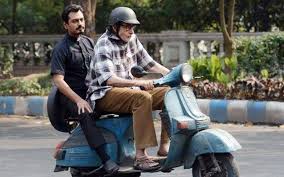
has company in the form of a reluctant Father Martin who joins and ditches him on and off, but John never gives up on what he is after. In many ways, this is similar to Kahaani. Someone after a case even the police have given up on, someone so weak and helpless that you would think that nothing would come out of it. No one feels threatened or intimidated by the person doing the digging around, the person just passes under the radar. If in Kahaani the perceived weakness came from the fact that the protagonist was a single pregnant woman, here it is an ageing man, well over 70 by the look of things. He seems so old that he can barely stand upright while walking, there is a permanent crouch, that perhaps came from riding a Bajaj scooter that doesn’t allow him to spread his shoulders and back to their full size (yeah, it’s funny how Big B can dwarf a hefty Bajaj scooter, having to crouch uncomfortably to ride it). The body language looks a bit manufactured at first, but we get used to it.
So, John Biswas is on the case in spite of the police and Father Martin telling him that there is nothing more left to be done. But the police are soon back on the case, and why? Because history repeats itself after 8 years, and that is where TE3N really begins.

Two tales, 8 years apart, converge to reveal what actually had happened, and in a complex script written with extreme caution and skill, we are kept guessing till the very end, and that is the victory of TE3N. The who, the why and the how of the crime are explained, one by one, not exactly in the same order in a non-linear narrative that goes back and forth between the two cases 8 years apart. The similarities are remarkable, in fact both cases are identical, which tells us that it is the same man behind both. As the script shifts back and forth between the two cases, there is a parallel track which shows John Biswas’ own investigation of what happened to his grandchild. This track, perhaps the most important one in the movie, is well shot, explaining each logical step that John takes in his investigation, but the editing is questionable. As the script shifts between his investigation and the police investigation, the time lines of both investigations is not clear. Maybe it is a deliberate attempt to beguile the viewer, but one feels the director should have been more honest with the delineation of the period separating the events.

TE3N is Amitabh Bachchan’s movie, he is the protagonist, looking for justice, not revenge and he
aces the character as usual with his unmatched screen presence. Nawazuddin Siddiqui too has to be given full marks for his portrayal of a priest who seems to be faking his peace and the fact that he has come to terms with his past. Whether his character is a genuinely funny guy is a bit of a doubt, because we can see that side of him only in the first scene inside the church. What the director wanted to convey through that scene, besides his personal views on marriage, is unclear. TE3N is also a very important movie because it is titled TE3N, which means it is a story of three people. We think the tree people are the three investigators behind the case in their own ways, the third being Vidya Balan. And yet, the titles tell us that Vidya Balan is making a guest appearance. One wonders, how a character that appears almost throughout the movie, does a lot of the investigation, is classified as a ‘guest appearance’; surely the longest guest appearance in the history of cinema. This is the kind of role that has enough screen time to be considered for a best supporting actress award. But it won’t because Vidya looks a bit off color, maybe because her character doesn’t have any depth and she just has to be a cop looking at evidence. The only hint of emotional depth in her character is the relationship she may or may not have had with Martin in the past.

Despite an excellent plot and classy performers, TE3N does feel a bit stretched towards the end. Things could have been tied off a bit earlier, maybe a little less drama. But, of course, the movie is all about how far a grandfather can go for justice because he loved his grandchild so much. TE3N is a movie worth watching.

Well-narrated complex investigative thriller

3/5

Saturday, 11 June 2016

THE CONJURING 2

Three years after the first one, The Conjuring franchise is ready with a sequel. The Conjuring may not count as one of the classics when it comes to horror movies, but it certainly has been the benchmark over the last few years, maybe being outshone only by the Paranormal Activity franchise, which normal cine buffs might find a bit too intense for an evening’s entertainment. The Conjuring has perhaps found the perfect middle ground of scaring just enough without putting the average viewer out of the comfort zone. The years that have intervened between the first one and the sequel have been flocked with horror flicks dime a dozen. Most of them have been underwhelming, including The Conjuring offshoot Annabelle and the highly anticipated Insiduous 3. So, hopes were indeed high while walking in for The Conjuring 2.
It starts off reminding us about the Amityville haunting which is perhaps the most talked about
haunting incident around the world. So, something similar is happening thousands of miles away in Enfield England, says a scrolling text as we’re shown The Conjuring 2 in the familiar bold yellow font. The setting is quite similar to that of The Conjuring, or any horror movie for that matter. Big house, 4 kids, man rooms, a cellar, a stair, plenty of stuff with which any supernatural entity can play havoc! It starts off as minor incidents – someone is sleepwalking, someone is thirsty in the middle of the night, some noises are heard thudding up and down the stairs, but no one really wants to take all that seriously. But then, someone decides that there’s been enough of the funny small stuff, and takes it up one notch. Now, we have a terrified bunch of kids and their mom who are sure that there is something in their house that wants them to leave. The police want to help but find nothing that they can do, the media gets in the act and soon it’s all over the papers, and before you know the church wants their experts to have a look at the place to confirm whether all this is real at all or just a hoax. That brings in Ed and Lorraine Warren.

All the way from America to Enfield England, they fly to know whether anything that is going on in the house is supernatural. They come, and they do get to see a few events, but nothing that makes it plainly clear. Quite surprisingly, the entity that didn’t seem too bothered about all events being public is not too eager about the Warren’s getting a good look at it. As Lorraine says, she just can’t sense anything. So, what is going on? Is it a hoax? Or is it something worse, more powerful, more evil than they have ever seen before?
The plot of The Conjuring 2 is as solid as the first one. The characters are quite relatable and draw empathy from the audience which is a major victory for a horror flick. The film is not a straightforward narration of the haunting. At different points in the narrative, we shift to the Warrens, who are not yet aware of the Enfield haunting, and we are shown that they are somehow connected or being dragged into this, just like the demon in The Conjuring wanted to harm their daughter. This thickens the plot. There is one particular scene in the Warren household with Lorraine Warren locked up in a study with an evil entity, which is quite chilling. The visual depiction of the entity is quite difficult to shake off for a while after the movie has ended.
As with any horror flick, The Conjuring 2 is all about how many times we jumped out of our seats.
The initial hour, where the entity makes the household aware of its presence is quite interesting and there are a few genuine jump scares and slow spooks. But, once the presence is established, and the psychological breakdown of the victim begins, things get a bit predictable. Some scenes, like the Crooked Man scene, fall flat. Once the Warrens enter, the tempo continues to be a bit flat for a while before it picks up right before the finale. It might be that we are quite used to the James Wan style by now and know where to expect the scares from, and so are not very surprised at ever event. But it all picks up with that one scene in the train where the recordings come together to make sense.
Vera Farmiga and Patrick Wilson continue to do the fine job they started in The Conjuring, with Vera growing even more into the role of Lorraine Warren. The music is a shade less effective than in The Conjuring while the camera does a fine job of keeping us guessing of what lies beyond the light. The Conjuring 2 is not as good as its predecessor, but it still has some genuinely scary moments and a good story. Easily the best horror flick in over a year from Hollywood. Go watch it.

Scares you enough to keep you on the edge!
3/5


Saturday, 4 June 2016

TEENAGE MUTANT NINJA TURTLES: OUT OF THE SHADOWS

It has been a relentless few months of superhero stuff, with DC and Marvel shooting one after another. Superhero flicks overlapping each other so much that we actually have trouble not mixing up storylines. Into this mix of Batman Vs. Superman, Captain America and X-Men, we now get the Teenage Mutant Ninja Turtles. Honestly, these are the real freaky superheroes of cinema, four brothers who are amazingly fast turtles, working from the shadows to protect the city the live under and love. The Turtles are definitely the lightweight superheroes of Hollywood when it comes to box office power, and the exhaustion factor of all these superhero movies so close to one another definitely dimmed the enthusiasm associated with the Turtles sequel. Actually, one can say that there was a degree of pessimism with Turtles coming into theaters, making expectations naturally a little lower, which might end up being a good thing!
So, how is the Turtles sequel? It is very much a regular superhero movie. The premise is very
straightforward; evil villain sets sight on total control over the world, and the turtles have to stop it. The unique factor with a turtles movie of course is that they have do it under complete anonymity, almost, working only at night, much like the Batman. Also, much like the Iron Man, the turtles are totally chilled out while kicking ass, giving away sage advice, sarcasm and cheeky lines all the time. The villain from the first movie returns in the sequel as he is plucked away into thin air from a police convoy. But it turns out there is a bigger villain waiting with more sinister plans, and then there is a mad scientist to facilitate the execution of said plans. There is nothing much about the plot that you cannot guess or predict.
But, offsetting that predictability is the pace at which the screenplay moves forward. After a racy title entry of the turtles, we are quickly taken into action. Megan Fox enters, and the cheerleader scene which was perhaps the single most hyped scene in the trailers is done away with quickly, and we are shown that the mad scientist is up to something. A road chase between a police van and a garbage truck later, we know that the scientist and the villain have schemed together to create a teleportation device, which would, as said in the movie, make Isaac Newton and Steve Jobs footnotes in the history of science. The USP of the turtles movie is that the action almost never stops, and the script has been written smoothly to flow from one encounter to another. To add to the excitement, we have a human rhinoceros and a human warthog, freaks who can match the turtles in the freakiness quotient. The showdown between them on the aircraft and then in a grand turbulent river is enjoyable.
By this time you have realized that the script has also got ambitious. It just doesn’t want to cause trouble in a city, it wants to end the world. And then we have some astrophysics, and space-time distortion stuff thrown in. To avoid spoilers, let’s just say that the proceedings at the end remind us a lot of what happened during the end of the first Avengers movie. But, the final confrontation has been well crafted.
Is there anything special in the new Turtles movie? No, absolutely not. There is nothing new that you
haven’t seen before. But, a tight no-nonsense screenplay, well shot action scenes, and witty/funny dialogues at some points, especially involving Will Arnett’s Falcon, keep things going along without making you feel bored. Stephen Amett seems to be a bit confused as to whether he is a hero or a sidekick. The writers have tried to bring in a bit of emotion, about the way the turtles feel about their place in society, but they have kept it to a bare minimum realizing it could hamper the flow of the action. You wonder what Laura Linney would do in this movie, and you are left wondering till the last scene, where some sort of justice is done to the casting. This one could be a fairly good way to have a fun evening.

Good visuals, good action, no yawns!

2.5/5

Sunday, 22 May 2016

X-MEN APOCALYPSE REVIEW

This was supposed to be a new beginning, effectively after Wolverine had travelled back in time to change the course of events in Days of Future Past. So, this was one movie that had evoked more curiosity than any of the other recent superhero movie; it was the X-Men story being rewritten all over again. We are taken to a point, about 8 years after the point where Days of Future Past left off. Professor is running his school, mutants in the outside world are still having a tough time, Magneto has been unheard of since the last event, Raven is out there somewhere.

Into this mix arrives the first mutant ever born, who has slept through the ages. He wants the world to
be ‘better’, to belong to the ‘strong’, and you know the Professor does not like anything that involves destruction, and neither do any of the people at his school. So, we return to a familiar premise, mutants separated by ideology going against each other. One side is headed by the Professor as always, but the other, more radical side, is not led by Magneto but by a greater mutant.

X-Men Apocalypse starts off slow after the pretty well made pre-title portion about the first ever mutant and the pains taken to keep him safe through the ages. We are shown Raven in the wilderness doing her bit to keep mutants safe, we are shown the Professor who is doing his good work with kids with the same optimism, and we are shown Magneto who is doing a normal day job as just anyone else. But great power cannot be hidden for too long as Magneto finds out, and his faith in humanity is shaken again. It might be a bit of a spoiler, but one cannot help say that the portion is way too similar to the fate Wolverine had to face in the Origins movie. Much of the first hour, even more, is spent on showing how the two sides get together. The great mutant gets his four horsemen together and the Professor is gathering his people, they both know that a confrontation is not far off. Even we know that, but it does take a mighty long time coming.

Quite a lot of time is taken up in the ‘recruitment’ process as the great mutant imbues his horsemen with amazing powers. That process just takes a lot of time and by the time we get to Auschwitz to harness all the rage that was suffered by Eric aka Magneto, we are tired, even through the scene where the concentration camp is blown to pieces, which must have been supposed to be a breath taking spectacle. For an X-Men movie, Apocalypse has too few confrontations, in fact there are just two, the rest is just dreary drama, which really doesn’t excite. The only other time we are excited is during the superfast movements of Quicksilver during a blast. Otherwise we are left to hear about the great ambitions of Apocalypse, the troubled mind of Jean, the grieving of Magneto and diplomacy of Professor. There are good moments in between, like the Moira McTaggort scene, but they are few and far in between.

By the time all the mutants gather in one place for the final face off, the audience is slightly
disinterested, and the movie has an uphill task of providing a climax that is worth the wait. Try as they may, it just doesn’t reach that level. The final confrontation is not anything that we have not seen before, again the most enjoyable moment here comes courtesy Quicksilver’s speed.

In the midst of all this the script manages to find time for Colonel Stryker to appear and where Stryker appears we know who else will. That is the biggest moment of the film, the Wolverine moment. Every X-Men fan loves when the Wolverine arrives and it never fails to excite us, but it is too small to lift the overall mood of the film.

In spite of the overall slow nature of the script, a first hour that just doesn’t let anything happen, X-Men Apocalypse sets a good premise for the new X-Men story to move forward. Michael Fassebender’s intensity as Magneto, James Mc Avoy’s finesse as Professor and the reliable Jennifer Lawrence as Raven keep Apocalypse watchable. And don’t miss the post-credit part, which give us a clue about how Wolverine might go forward.

Slow, meandering, but watchable!
2.5/5